

The Dangerous Future of Valve's New Child - Deadlock

Updated: Feb 23
is an upcoming, unreleased 6v6 MOBA (Multiplayer Online Battle Arena) / third-person shooter where two teams push lanes and try to destroy each other’s Patron, set in a steampunk-flavored New York City. First entering public view in summer 2024, the game has remained invite-only and in an early alpha-stage test ever since. And as a Dota 2 player, it was hard for me not to hop in and get a taste – especially with the talk that this is a spiritual successor to Dota 2, allegedly led by IceFrog.

Valve is a Rebel
If you look at the video games out there right now, especially the new ones, it feels like most of them are trying to do the same thing: make the first hour experience painless – faster onboarding, easier mechanics, fewer things to track at the same time, and shorter playtime each round. As we all live in a fast pace world now, most big studios know that players these days don’t have the patience to slowly learn a game from zero for ten hours and build up loyalty from gradually intensify playing, but rather want to hop on to a rewarding experience fast and easy in a relatively short time, of which they tend to not play each game for a long time as well.

It is the new reality, and I believe Valve knows it, as they had done some similar things in both their flagship titles to help players onboard, especially in Dota 2 where after all these years, they finally renovated the entire beginner’s guide to help new players and had updated a lot of guidance features just to help players easily navigating through its systems. However, Valve is not a studio that will just give in. Take Dota 2 as an example again, where apart from those I mentioned above, the patches from the past few years were actually leading the game to the opposite – bigger maps, more systems, more items, longer gameplay, and harder new heroes. It almost feels like Valve has this weird confidence that most studios don’t have anymore: they’ve chosen depth over comfort.

This was what I felt when I played Deadlock for the first time back in 2024. To me at the time, as I hadn’t heard a lot about this game, I was imagining a playing experience closer to Overwatch, where it might be quite focused on the blend between two demanding genres – a hero shooter with some extra strategy layered on top with the use of abilities. I was so wrong – it was a blend, yes, but it’s a blend where none of the complexity gets shaved off.


A Shooter? Or a MOBA?
On the surface, Deadlock looks like a shooter: third-person camera, guns, range abilities, and long TTK (Time To Kill). The first few minutes can trick you into thinking it’s going to be “aim + teamwork + ult timing,” and if you’re coming from hero shooters (like Overwatch), your brain naturally tries to play it that way – find an angle, take a duel, win the fight, push forward.
But the longer I played, the more I realized Deadlock is not a shooter. Yes, it still has the most characteristic of a shooter – if you aim better, react faster, position smarter, you can likely brute-force value, and if you are good enough, you can be “down” as a team and still clutch fights through pure personal execution. But most of the time, Deadlock keeps pulling you back to a different kind of reality than a typical shooter: it cares more about teamwork, the item buildup, the ability combination, and the economy. Some might argue that this is a bit like Counter-Strike, where players need to play as teams, coordinate with each other on item usage, and each round results in a monetary reward. That is just thinking this way too simply – where can you see the difference in the economy that can result in a cliff-like gap in hero powers in Counter-Strike?

It is a MOBA, or I would prefer to call it “Dota-like”. Shooter is just an “add-on” to it to give it another layer of playable mechanics, where the main verbs are actually the same as Dota: build and push. And once you accept this, everything starts to click.
The lanes aren’t just “something happening in the background while players fight.” The lanes are everything. Minions keep marching, creatures keep spawning, money keeps flowing with farming, and if you ignore that flow, you fall behind in a way that doesn’t feel dramatic at first — until it suddenly does. You might take a clean duel, hit your shots, use your abilities correctly, and still lose. It is not due to your skill at the duel, but due to the fact that your opponent is simply more online. More laning, more farming, more building up, more pushing forward, results in more items, more upgrades, more options, and more chances to win. That’s a very Dota feeling: sometimes you don’t lose because you played the fight wrong, you lose because you have already fallen behind five minutes ago.


The shop system makes this identity even louder. In a hero shooter, your character is basically your kit — you pick a hero and you “are” that hero for the rest of the match. In Deadlock, your hero is more like a starting blueprint. Your build isn’t a bonus; it’s part of your role, your timing window, and your win condition. You’re not just learning what your hero does. You’re learning what your hero becomes depending on what you buy, what you upgrade, and when you hit your spikes.

That’s why Deadlock can feel deceptively unfair for newcomers. In a shooter mindset, losing a duel usually feels explainable: aim difference, positioning difference, reaction time difference. In Deadlock, you can lose a duel and not even understand why — because the reason might be buried in five minutes of macro decisions, farming efficiency, build choices, and team coordination that happened before the fight even started. The shooter part is visible, while the MOBA part is invisible, and the invisible part is often the real factor determining the outcome.


So, when people label Deadlock as a “MOBA-shooter,” I think the order matters. To me, it’s not a shooter with some MOBA flavor - it’s a MOBA with shooter hands. And honestly, that’s already a lot. Yet Valve didn’t stop there. Because the second you start getting comfortable with this “MOBA-shooter” idea, Deadlock hits you with another layer of skill expression that most MOBAs don’t have at this scale: movement.
Dazzling Movements
If the MOBA layer is what makes Deadlock mentally demanding, the movement layer is what makes it physically demanding — and also what makes it look so damn cool. Deadlock’s map doesn’t feel like a flat battlefield where you “rotate” from point A to point B. It feels like a playground built in three dimensions. There are height advantages, angles from rooftops, escape routes that only exist if you’re comfortable with your movement options, and fights that don’t just happen in a lane — they spill over the lane, above it, behind it, and sometimes straight through it. It’s the kind of map where you can watch someone who knows what they’re doing and instantly feel the gap: they aren’t just moving faster, they’re moving smarter.
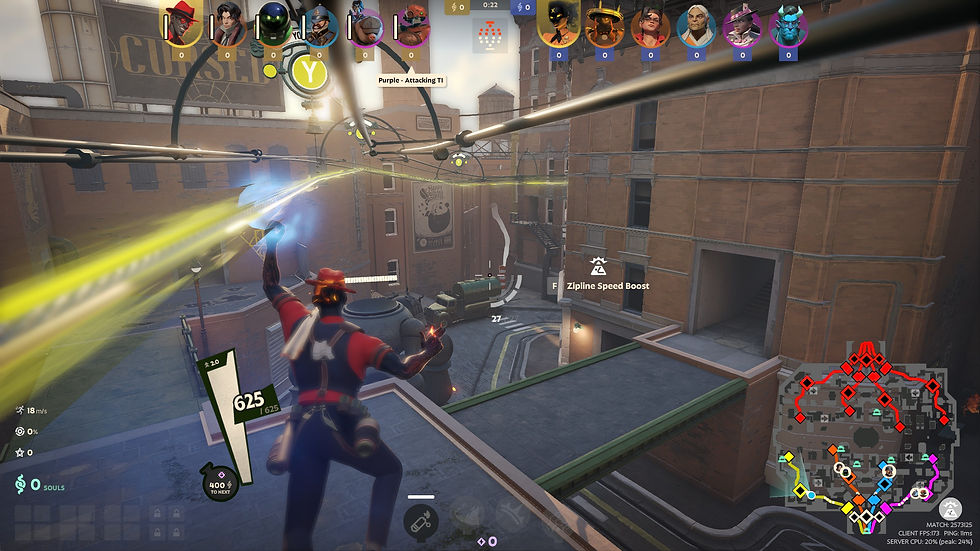
The basic act of moving is already a mini skill check. It’s not “hold ‘W’ and occasionally jump” (or continuously jump if you are from Overwatch :)). You’re thinking about momentum, timing, stamina, and how to chain your movement options smoothly. Then you stack that on top of aiming, ability usage, item timing, and laning macro. If Dota 2 is a game where your brain is constantly multitasking, Deadlock adds a new layer where your hands are needed more than ever for multitasking, too (yep, you can't bet to play this "MOBA" game with just the mouse).
That’s where the “dazzling” part comes from. Deadlock can look like a highlight reel even when nobody is doing anything flashy on purpose — simply because the movement system enables normal gameplay into a more dynamic flow. A chase isn’t just a chase - it becomes a parkour puzzle. A retreat isn’t just backing off - it becomes a sequence of movement choices: break line of sight, change height, calculate stamina, apply abilities, and suddenly you’re gone. Even basic engagement feels different since verticality means positioning isn’t only left-right, but up-down too.
And here’s the catch: this dazzling movement is the exact reason why Deadlock might be intimidating to a lot of players. As it is not a cosmetic skill expression in Deadlock, movement is crucial for survival in the game. If you can’t use the map well, you can’t escape well. If you can’t escape well, you feed. If you feed, you fall behind. And if you fall behind in a MOBA economy, the game doesn’t just punish you — it snowballs you, while your opponents also snowball from you.
So, the difficulty isn’t just “learning the heroes", or “memorizing the items”, or "understanding lanes”, or "familiarizing the map". It’s all of these plus the ability to physically perform in a three-dimensional space without getting lost, without getting caught, and without wasting time. That’s also why watching good Deadlock players is both inspiring and intimidating. The ceiling is insanely high - way too high for most players to reach.

I Like It, But I’m Not the World
I am a Dota 2 player, maybe not a hardcore one, but definitely one with a long time devoted to it (more than 3,000 hours). That’s why I fell in love with Deadlock really quickly – it is what I can comfortably grab on to and shine due to all the similarities. Beyond that, I also like to play a lot more “hardcore-ish” games. I like games that ask me to suffer a little before they start feeling good (like Rainbow Six Siege). I like games where the fun is not just in winning, but in understanding (like Stellaris and Heart of Iron). I like the feeling of slowly building a mental model — learning matchups, reading the map, memorizing items, discovering weird synergies, and finally reaching that moment where everything starts to click (like EVE Online). And all of these are literally why I still play Dota 2 to this day – not because it is relaxing (it’s not), but because it keeps making me feel like I am learning something.


So when Deadlock throws complexity at my face, my reaction is not “this is too much”, but rather “Ohhhh! The game is on!” It feels like a game that respects mastery again, that Valve is building something with a long-term ceiling, not just a short-term dopamine loop. But that’s exactly where the danger is. Cause the same features that make Deadlock exciting to someone like me are also the same features that make it hard to recommend to most people I know. The moment I try to imagine introducing this game to a friend who mainly plays casual shooters, I can already hear the questions:
"Why do I have to farm?"
And honestly, I don’t have an answer for it. This is the same problem with Dota 2 and other MOBA games like League of Legends, where the "homework” is part of the fun. You don’t just show up and start shooting, you need to go through a whole set of "vocabularies" to be able to reach the glory. Though I enjoy this process, most players simply don’t. Instead of “climbing a hill” and eventually seeing “sunrise” at the peak, most players want to see the “sunrise” from sea level straight. They want simpler mechanics, clearer feedback, and matches that reward positively even if you’re new. What they’re preferring are experiences where you can hop on after a long day, play a few rounds, laugh out with friends or strangers, and log off, without needing to find a chart on a wiki just to help their friends heal in-game.
That’s why Deadlock feels risky to be a game in this era – it is not that the game is bad, it is just that most players don’t want to put too much commitment into a single match.
Where does that leave Deadlock?
Right now, since it’s still unreleased, still invite-only, still in that “everything can change tomorrow” stage, it's hard to predict in a clean, confident way. Valve could still decide to smooth out the rough edges, compress the learning curve, or redesign entire systems before the real launch. Deadlock today might not be Deadlock a year from now (just like how they changed from four lanes to three lanes last year, and polished the art style significantly).

But I do think the direction is already clear: Valve is not making a “fast food” game - they are making a “fine dining” game. And this means Deadlock’s future is probably going to split into two very different paths:
Path one - it becomes the next forever game, just like Dota 2.
The best-case scenario is that Valve successfully builds a new competitive ecosystem the way they did with Dota 2: a game with depth, a strong identity, a community that never runs out of things to learn, and a meta that evolves for years. In this future, Deadlock doesn’t need to be loved by everyone. It just needs to be loved intensely by enough people to become a culture.

Path two: it becomes a “legend that most people don’t play”, still kinda like Dota 2 :)
The worst-case scenario isn’t that Deadlock is bad — it’s that Deadlock is too much for the modern market. Not because players are incapable, but because attention is limited. If the onboarding cliff stays this steep, it could turn into one of those games that everybody respects and watches highlights of, but only a smaller hardcore crowd actually sticks with. A game that always feels one step away from mainstream, yet never fully crosses that line.

And honestly, I think Valve is aware of that tradeoff and might even be okay with it. If you look at how Valve operates, they rarely chase “maximum audience”. Instead, they prefer to chase “maximum identity”. They tend to build games that become reference points – the kind of games people compare other games to. Even unfinished, I think that Deadlock already has that energy, where it doesn’t feel like a copy of what’s trending, but feels like Valve trying to set the trend, trying to prove that maybe the market doesn’t always want simpler, maybe sometimes it wants deeper.
So, the real question isn’t whether Deadlock will be good. It’s whether enough people still want this kind of game. Are we ready to climb again—or do we just want the sunrise at sea level?

Comments